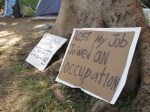
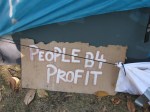
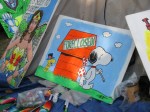
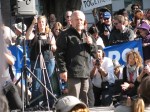
It’s been just a little over a month since the 99% began occupying Los Angeles City Hall, so I spent a few hours there this afternoon. There was a lot of talk about legalizing medical marijuana. I took some photos and here are some of the shots:





























Gov. Jerry Brown signed the Dream Act in to law this morning, and I think it was a step taken in the right direction.
One of the first stories I wrote during my first semester on staff for El Vaquero was about AB540 students, and one of the students I spoke to, David Garcia, told me a pretty compelling story. He lived in Canoga Park at the time, and it took him three hours on three different buses to get to Glendale College.
The students I spoke with for the story were at a booth on campus, putting themselves out there. I wondered if they were at all concerned with the fact that they could face some serious repercussions for putting themselves out in public like that. Garcia said there was a little bit of fear, “But we’re out here letting you know that we exist and that we have needs and that there is a type of oppression that we have trouble with.”
Most AB540 students are brought across the border when they’re still children, when they don’t really have any choice but to go with their parents. So for them, this is all they know. Then a sophomore, Leticia Lopez said in 2009 that she’s been in California since she was 1 year old.
“I’ve been here since I was one year old. I practically grew up here, so I don’t know any other place,” she said.
Without status, AB540 students can’t really do much after graduating from college. They might have a degree, but can’t get jobs because they’re not here legally.
There are promising undocumented students who, with the Dream Act now law, will contribute to American society. They’ve lived here their whole lives, gone to school here, established lives and friends here, and it wouldn’t be easy for them if they were forced to go to a country they know little, if nothing, about.
Kudos to Gov. Brown for singing the act into legislation today. It’s going to be a big help to so many of the AB540 students who invest time into their studies and are determined to better their lives.
It’s not new that girls are heavily pressured to look beautiful in the way the media defines it. From lengthy lashes and rosy cheeks, to perfectly straight hair and an hourglass figure, it’s virtually impossible to attain that kind of beauty without relying on cosmetics, gym memberships, and even plastic surgery.
My cousin Andie just turned 11 a few days ago, so she’s at a stage where she’s becoming more conscious about her appearance. Her self-consciousness has been a work in progress, but now she’s beginning to nitpick at her ‘imperfections’ more than compared to three years ago.
She recently got her own hair iron and has started straightening her hair multiple times a week. She also has a set of makeup that she plays around with on a regular basis. Several weeks ago her mom denied her permission to dye her hair, and she became very upset.
I’ve tried to explain that by using a hair iron she’s burning her hair. I also tried to tell her that because she’s so young, she’s still got really good, soft skin, and that the only thing makeup would do is damage her skin in the long run.
Of course if skin is cared for properly and washed thoroughly after makeup use, that helps. But then there’s also the fact that if makeup is worn on a daily basis, a girl looks different (usually worse) without it on.
But when you’re that young the repercussions don’t really matter. And even when girls are older the consequences don’t really matter because it becomes routine to put on the foundation and eyeliner every day. And it doesn’t matter because we’re surrounded by celebrities who use cosmetics all the time.
It’s not necessarily a bad thing to wear makeup, but it shouldn’t be used as frequently as it is. Humans aren’t born with symmetrical features or the types of faces and bodies that are airbrushed and edited in magazine covers. Most women are pear-shaped as opposed to having an hourglass figure because their bodies are designed to bear children. So it’s impossible to attain the beauty of Victoria’s Secret models without going through countless measures. And when a girl gets to that point it’s not natural beauty, and the girl probably still isn’t going to be happy with what she looks like.
There’s no reason for girls feel insecure about themselves, just as Andie is starting to be. Instead of focusing on how to imitate the appearance of everyone we see on TV, we could be focusing on more attainable goals, like bettering ourselves, other people, and our communities.
In China, if you need to use the restroom at a public place, you have to let everything out into a hole in the ground.
I spoke to a friend last week who spent two weeks in China this summer, and the public toilet situation was the highlight of our conversation.
“It’s funny because in the house, everyone has a toilet,” he said. “But at the mall and other public places, there’s no toilet! You don’t even have toilet tissue, you have to buy your own!
“And it’s hard because there’s no toilet seat!”
Because China is a communist country, I wondered why restrooms aren’t a component of public facilities. Then my friend reminded me that the United States owes China a lot of money, $1.2 trillion according to the Huffington Post.
Perhaps if the country had that money, it’d have some public toilets.
Our discussion about toilets and America’s debt interestingly led me to think about how the news never mentions who is benefiting from America’s debt. The money the United States is borrowing is being spent somewhere, and whoever is receiving the money is probably well off.
But that’s not something we hear about.
From personal profiles and games to event listings and business pages, Facebook serves a number of diverse purposes for more than 750 million users.
For Sparr Heights, a neighborhood located in northern Glendale, Facebook Groups has emerged as a popular function of the networking site. A group called “Sparr Heights Neighborhood – 91208” was created in June 2010 and serves as a virtual neighborhood watch program for the community.
“I wish every zip code had [a Facebook group],” Evan Gore, founder of the Sparr Heights Neighborhood – 91208 group, said.
Gore created the group after his high school reunion and after his house got robbed, both of which occurred last year.
“[The robbery] sort of got me more mindful of wanting to tell people and communicate with neighbors,” he said.
The group currently has more than 180 members who also use the group as an open forum to make announcements about various topics, from yard sales to upcoming events.
“It’s a great way to advertise neighborhood events that one might not know about otherwise,” said Lynda Hessick, a member of the group.
Unusual observances are also posted on the group’s wall. Recent concerns include recurring helicopter noise earlier in June and American flag thefts in early July.
Apart from these purposes, members use the group to announce if they’re giving things away, ask for recommendations on professional services (like for good plumbers and accountants), look for missing pets and seek resources from others.
While not all members are personally acquainted with one another, the group has fostered an online sense of community that has even assisted newer members in becoming more acclimated to the area.
“[Everyone] is sharing information and so welcoming and friendly,” said Valerie Robinett Joico, who just moved to Sparr Heights from San Francisco. “It has helped us with our daily lives as well as our social lives. As far as neighborhood watch is concerned, it gives such good info and everyone has each others back … that helps me sleep at night.”
Additionally, the Facebook group has served as a platform for members to organize donations for a family whose house burned down a few months ago, as well as donations for a needy family last Christmas.
The Sparr Heights Neighborhood Facebook page is open and visible to the public, and although privacy has long been a concern with the networking site, Gore doesn’t think the issue is something to worry much about. He hasn’t seen any evidence of abuse and pointed out that people can adjust privacy settings so as to share only specific information.
For Gore, one of the more positive outcomes of the way Facebook works is that he has developed acquaintances with people in the neighborhood who have recognized him from his profile photo.
The group has been up and running for a year now and users continue to use it as a means of informing fellow members and seeking information.
“I’ve asked for information, referrals, ideas and never been disappointed with the results,” group member Renee Brandt said. “I know the people offering input and trust it.”
http://www.crescentavalleyweekly.com/news/08/04/2011/neighborhood-uses-facebook-to-keep-watch/
The news this week has been dominated primarily with stories about the government budget, particularly raising the debt ceiling.
I found a link with an interactive way to view the budget allocations for 2010:
http://www.nytimes.com/interactive/2010/02/01/us/budget.html.
Common Dreams also posted an article on its website on July 12 with a helpful visual of the way money is distributed:
http://www.commondreams.org/view/2011/07/12.
In the first link, there’s an option to “Hide Mandatory Spending” and if you click on that, it’s pretty shocking to see how much non-mandatory spending is devoted to the military. And in the second link, it’s impossible to wonder why more than HALF of the discretionary budget is spent on the military.
Several of my friends and acquaintances are in the military, and of course their service to the country is appreciated. But with the humongous chunk of money they’re getting, it’s really frustrating to hear about continued cuts in areas that, in comparison to the military, receive such minute portions of the budget, particularly education.
There’s always news about teachers being cut and school programs being eliminated, but I have yet to hear any of my friends in the military complain about salary cuts or anything like that.
Politicians like to talk about the importance of education in America. If that’s the case, then why is it that education only received 4 percent of the discretionary budget? The high value the government places on education combined with the amount of money it receives doesn’t add up.
With 58 percent of the discretionary budget devoted to the military, the rest of the discretionary programs receive single-digit percentages of that budget. Why does food only get 1 percent? Veterans, who have already served the country, get a measly 5 percent of that money? Aren’t we pushing for green energy? If so, then why does that area only get 6 percent?
Right now the country is in serious debt, and Congress is working on raising the debt ceiling so that the US doesn’t default on the more than $14 trillion it owes (U.S. National Debt Clock at http://www.brillig.com/debt_clock.)
Maybe I’ve missed some news about cuts in funding for the military, but so far it’s all the other programs with little money taking the hit.
If we want America to continue to prosper and if we want to take steps to fix the budget, then cuts need to be made fairly. It does not make sense to take money from programs that barely have financial resources, and not take money from programs that receive significant funding.
Two days ago I received an email from borders.com announcing that the company is shutting down, and I’m completely bummed. I bought several used books there a couple of months ago and I got them all at reasonable prices, in good condition and in a timely manner.
In the email from Borders CEO Mike Edwards, one of the reasons given for the company going out of business is because of the whole eReader revolution. I guess it’s become tough to compete with technology like the Amazon Kindle, the Barnes and Noble Nook, and eBooks on Apple Devices. The company did have an eReader called the Kobo, but it looks like it wasn’t enough to save Borders from closing its doors.
While Barnes & Noble continues to flourish, it’s sad to see Borders go. It’s always great having another store to go to for books.
There was an insightful article about parenting published in the latest issue of “The Atlantic” called “How to Land Your Kid in Therapy” written by Lori Gottlieb. She wrote about how when parents try to raise their kids’ self esteem and do whatever is necessary to make them happy, they may actually be doing the opposite.
Parents want what’s best for their kids, and a lot of times it seems like they’re willing to sacrifice an arm and a leg to make sure the kids are happy, even if it means protecting them from the hardships that could pose challenges while they’re growing up.
There was one example given in the article about two children fighting over a toy, and one of the kids’ mother swoops in to make sure her son got to play with it because he got it first. Instead of letting her son resolve the little conflict, she solved it for him.
Of course parents want their kids to be happy and pampered. It feels nice to see bright smiles emerge on their faces when they’re given what they want. It can feel good to know that you’ve stepped in to help them solve their dilemmas, and maybe it’s partly because it feels good to know they depend on you.
The thing is, rejection and hardships are inevitable. It’s a part of life and no matter how much parents try to protect their kids from bullying peers and negative feedback, they’ll eventually get a dose of it. And if they’re constantly reassured “it’s not you, it’s the people around you,” how are they supposed to deal with it later when mom and dad aren’t there to tell them that they’re great?
The case of the two children fighting over the toy is an easily resolvable squabble that the kids could figure out on their own. It’s fine to let kids work out their own problems. Mom and dad can be there for advice, but they shouldn’t always be there to fix things. Unless the problem is something way out of hand, it’s probably fine not to step in and just let children fix the problems themselves.
There’s this cliche saying about “learning the hard way,” and while it’s probably a last resort for a lot of parents, it’s a saying that exists because people do tend to learn the hard way. When people endure hardships, they learn because those kinds of experiences stick. If someone were to become so broke that they had to live out on the streets, they’d learn how to fend for themselves and remember how difficult it is to live without a roof over their head. And if the time came that the person eventually got to live in a house or apartment, they’d likely to be smart about their money in fear of living out on the streets again.
July 14, 2011

“I’d been thinking about [climbing Everest] for a long time,” Nelson said. “A year ago I realized, given how old I was and the fact I fall out of shape so fast … that it was either now or I probably wasn’t going to do it.”
At 52, Nelson, a lawyer specializing in trademarks, is an avid climber.
“He climbs mountains because with every climb, there is a goal which is to reach the top,” his wife Sherrie said. “The satisfaction of reaching the top is what drives him to climb more mountains.”
In addition to Mount Everest, Nelson has tackled Mount Kilmanjaro, the highest mountain in Africa; Denali in Alaska; Aconcagua in South America; and Mount Elbrus in Russia.
The La Crescenta resident began preparing for the climb last summer when he scaled Mount Baldy. He also worked out regularly on a stepmaster.
Nelson’s ascension to the peak of Mount Everest involved going up the mountain and coming back down three times to help his body acclimate to the change in altitude. There were a total of five camps where trekkers would rest before continuing their way upward.
He reached the top of Mount Everest at 7:45 a.m. on May 19, beginning his final ascension at 9:45 p.m. the previous day.

“Summit day was pretty fun. [It] was pretty spectacular,” he said. “It felt great. The weather was perfect. There was no wind, and it can get vicious up there.”
Although Nelson was physically fit enough for the climb, he developed a mild case of pulmonary edema, a condition in which fluid builds up in the lungs. The buildup in Nelson’s lungs was due to the rising altitudes. He had to see a few doctors, but the damage wasn’t permanent.
“What [the pulmonary edema] does do is probably make me more susceptible to it [in the future], should I go up that high again. And so it’s something I have to worry about now if I ever climb [Everest] again,” he said.
He added that he didn’t observe symptoms of the condition unless he was higher than around 23,000 feet. He does intend to take precautions for future climbs by bringing medication along.
Scaling up thousands of feet in the snowy slopes of Nepal where temperatures dipped below freezing required Nelson to wear a special suit that weighed five pounds. And while ascending with the extra weight posed a challenge, he found going back down more difficult.
“Coming down you have more opportunity to fall,” he said. “That’s why it’s easier to get hurt.”
In fact, during the climb Nelson fell into an ice crack covered by snow, causing his left knee to twist. He also banged the same knee against the Hilary Step, a rock face well known to climbers near the top of the mountain. Yet despite this injury and the pulmonary edema, he successfully made it to the top of the mountain, back down and returned home in mid-June.
“Once he made the decision to take on this climbing challenge, I knew very little would prevent him from achieving this goal of summitting Everest,” Sherrie said. “He doesn’t back down from anything in life unless there is a really good reason.”
Making it to an altitude of more than 29,000 feet may seem a daunting goal, but for Nelson, it serves as a useful reminder.
“I need to constantly remind myself that I can do things that I don’t necessarily think I can do when I first think about it,” he said. “Climbing … eliminates your excuses of why you can’t do things.”
http://www.crescentavalleyweekly.com/news/07/15/2011/foothill-resident-stands-amidst-the-clouds/
June 8, 2011

She’s a descendant of a former Philippine president, but that’s not how Jamie Avanceña wants to be labeled.
“I want people to know me for me, [not as the great granddaughter of former President Jose Laurel],” the San Marino resident said.
Avanceña, 23, is initially shy when it comes to meeting people. It’s not an expected personality trait of athletes or aspiring artists, but she is: an athlete, an aspiring artist, and, at first encounter, she’s a bit shy.
It is clear from her activities that Avanceña has a knack for sports. At the age of 4 she began playing golf, and at the same time she took ballet, tap, and hip-hop dance lessons. She began playing softball when she was 7 years old, and continued playing the sport in middle school and high school. In 2001 and 2003 the teams she played for won the Little League World Series, and beat Arizona in the 2002 USA Nationals.
Avanceña attended GCC from 2006 to 2008 and was nominated softball team captain in the 2007-08 school year. During her attendance at Glendale, she ranked in the Western State Conference.
“She was probably one of the hardest workers and one of the finest kids we had as a leader,” softball coach Dave Wilder said. “[She was] absolutely the greatest kid … [she was] a very, very good student. [She] worked hard, never talked back and was always there for everybody.”
In the time she played softball, Avanceña received the recognition typical of star athletes. But that type of attention wasn’t something she sought.
“The only reason people knew me was because of sports,” she said. Beyond that, people didn’t know much about her and she even felt invisible.
Avanceña was offered a full scholarship to the University of the Philippines for her achievements in softball, and she attended college there for a year. Yet despite where her athletic talent landed her, she relinquished her scholarship and came back to California.
While her mom wanted her to play softball, she didn’t know for sure if playing for the national softball team of the Philippines was her dream, or if it was her mom’s.
“I grew up with a family where I felt like I couldn’t be myself,” she said. “I felt like I was in their shadow.”
Other members of the aspiring artist’s family were active in Philippine politics. The sons of former President Laurel became vice president, senators, and congressmen. Some other relatives include a former Minister of Labor of the Philippines and a current justice in Makati City.
She doesn’t intend to follow in her relatives’ political footsteps, but Avanceña sticks closer to the path of her uncle, Cocoy Laurel, an artist who has performed on Broadway.
Last summer she released her first album containing four R&B tracks. She co-wrote the fourth song on the album, “It’s My Time,” which is about her breaking out of her shell.
While Avanceña is pursuing a career in music, she admits to not always having had the qualities of a singer.
“The funny part is, growing up I couldn’t sing, I couldn’t dance, I had no tone, no beat,” she said. Despite this, she said singing has always been her passion.
Avanceña first got into music when her grandmother, who she calls Lola Julie, encouraged her to sing karaoke when she was younger. The first song she learned to sing in tune was “Always and Forever” by the funk/disco band Heatwave.
Because she was close to her grandmother, Lola Julie’s death in 2005 presented a difficult time for the then-San Marino High School student. After getting through it, she decided to take a risk and see where her R&B music career would go.
“To this day whenever I sing I make sure to [also] sing for my other grandmother, my Mama Rose [who recently passed away],” she said. “I really sing for them and I got closer to God because of my grandmother Rose because she was in the Catholic Womens League.”
In the Philippines, Avanceña became a song leader in church because of her Mama Rose’s involvement there.
The stepping stone for the aspiring artist was when she auditioned for Tawag Ng Tanghalan, a singing competition, in 2008. The contest was held at the LA Convention Center, and she brought a CD that was incompatible with the player. She was left with no choice but to sing a capella, and she still managed to win third place.
“That’s when I realized to really believe in myself,” she said. “It gave me that confidence. I thought, ‘If the judges see something in me that I don’t see in myself, maybe I’m really meant to do this.'”
She is currently working on her next album with music producer and artist Big Rod from Fun Factory. Big Rod has worked with big names in the music industry including the Backstreet Boys and music manager Johnny Wright.
While Avanceña continues overcoming her shyness and trying to let loose, the music producer said the aspiring artist has a personality that’s easy to work with.
“She’s been an athlete all her life so she’s used to taking critique and then adjusting her game to it, and that’s what she does with her vocals also,” he said. “If I have a problem, I let her know, and she fixes it.”
Another positive aspect Big Rod highlighted about the singer is the unique vocal quality she possesses.
“Her voice is kind of a shape shifter,” the music producer said. “She can make her voice do what it wants to do. She has power … but she can bring it down and sing nice and mellow.”
The Filipina singer is wrapping up her second semester at Pasadena City College and preparing for her upcoming album. She has been listening to dance tracks and ballads, as these are the types of songs scheduled to be featured on her new record. She’ll also be moving to the Philippines during the summer to further her music career.
Despite having faced a lot of uncertainty before finally deciding to pursue a performance career, Avanceña recognizes the hurdles she’s faced as ones that have shaped her character.
“Everything that’s happened in the past has built me into the person I am today,” she said.
 Agnes Constante