Therapy can liberate your world

Daily Sundial
May 8 2013

It’s no secret that individualism is a characteristic of American culture. People take pride in achieving goals and handling matters on their own. However, it is because of this mindset there is a negative stigma associated with going to counseling.

Seeing a therapist doesn’t mean you’re damaged, and you don’t need to have a mental illness or disorder to visit one. Seeking professional help is not a sign of weakness, nor is it a negative resort to sorting out your problems. After all, people work in groups all the time to figure things out so why should asking for assistance when it comes to personal circumstances be perceived negatively? It is unfortunate that this stigma still remains in society because the benefits of going to a therapist are positively life-changing.

At the same time, it’s imperative that we remember that seeing a counselor is far from easy. The most challenging part is to acknowledge that you might need some help and thus decide to making the initial appointment.

Last fall, I made a call to meet with a therapist at CSUN’s University Counseling Services (UCS) for the first time. I had toyed with the idea for a few semesters because some things were becoming difficult for me to deal with on my own, including anxiety from school. But I frequently found myself “too busy” to call, let alone finding time to pour my soul out to some trained stranger.

Telling the receptionist I wanted to make an appointment for “psychological counseling” was tough in and of itself, but dealing with the feeling of defeat after ending the call was even more mind-boggling. Was I truly unable to solve my own problems?

Throughout the process, what’s interesting is that my therapist never felt that she needed to “solve” my problem. My therapist never imposed her views on me, but rather clarified my sentiments and asked me questions that guided me to answers I had within myself.

In the end, it wasn’t so bad. In fact, there was nothing bad about it. There was nothing bad about gaining a refreshing degree of self-understanding that helped me grasp my personality and realize why I act the way I do in certain situations. And there was nothing bad about figuring out how to take steps toward improving myself in areas I wanted to develop.

UCS offers eight free one-on-one counseling sessions to current students per academic year. That’s quite a deal, considering that sessions at private practices cost from anywhere between $150 to $200.

Once my individual sessions expired in December, I signed up for a group – with some reluctance – at the beginning of this semester. I had learned to trust one therapist, but now I was moving on to open myself to a new one and five to eight other CSUN students.

My biggest fear was that they would judge me and tell my stories to others.

But neither of those things happened.

Each member came into the sessions with an open mind and suspended judgment because we all had identical reasons for attending group therapy: to further nourish a better understanding of ourselves and to grow as human beings. Of course there was an initial discomfort in opening up to an entire group, but as the weeks progressed, the inevitable rapport that develops when spending a lot of time with the same individuals surfaced.

The dynamic in group therapy is unique. It becomes a safe place to become vulnerable among peers who aren’t necessarily friends.

The beginning of each one and half hour session in my group consists of asking how our week has been. If we have specific issues we want to share with the group, we request for time to discuss it. Members then listen, ask questions, and share if anything said resonates with us. Not long after the group began, meeting with my group members became one of the highlights of my week.

As far as privacy goes, I have no doubt that everything I’ve shared with the group has stayed within the walls of our meeting room in Bayramian Hall. As it is with one-on-one counseling, therapists and group members are required to maintain confidentiality of all clients, except in certain cases, such as if a person is believed to be a threat to themselves or others.

The beauty of this type of therapy is that it becomes a support group where all members are generally able to provide input that is more objective and constructive than if we spoke to our friends. This is because none of us are involved in any of each other’s lives to such an extent that would bias our responses in discussions.

Some people defend not going to therapy because friends and family are there to listen. And at times, that’s really all that is needed.

However, psychologists are trained to do more than just lend an ear. They are trained to understand the roots of the discomforting symptoms people may be experiencing, as well as ways to help students get “unstuck,” according to Mark Stevens, director of UCS.

Sometimes it’s not enough to hear that friends “understand exactly” what you’re going through, and close involvement in someone’s life can result in subjective suggestions in how to handle difficult situations.

Going to a counselor for help is tough for more reasons than just the stigma. In some cultures, talking negatively about family to a stranger may result in a feeling of embarrassment or the feeling that one has dishonored their parents, Stevens said.

Others simply don’t trust the confidentiality by which licensed psychologists are bound.

However, what is important is that people are able to share how they feel while knowing that they are truly heard and listened to. In some cultures, people may find it effective to simply speak with a minister or priest, or aunt or uncle, Stevens said. For those who do this and find they need more, he suggests considering professional help.

Going to therapy may still be ridiculed, but the journey in examining old wounds and exploring feelings is enlightening and empowering. UCS offers incredible resources for students that those who have yet to use may want to consider.

Opening up and exposing uncharted emotional territory may be an uncomfortable hurdle, but doing so is a sign of strength, not weakness, and is a step toward a fulfilling state of self-awareness.

—Agnes is a graduating senior who wishes she had gone to therapy much earlier. It is for this reason she wrote this piece and hopes others consider therapy, including the services offered at UCS.

http://sundial.csun.edu/2013/05/therapy-can-liberate-your-world/

Kinesiology professor challenges students to complete the LA Marathon


Andrew Polgar, 25, a kinesiology major trains for the LA Marathon. He ran 16 miles on Feb. 2 with a group of CSUN students, staff and alumni. Photo credit: Loren Townsley/ Photo Editor

While most people are still asleep as the sun creeps up over California’s skyline on weekends, the opposite is the case for runners training for the LA Marathon.

By 7:30 a.m. on Saturday, about 60 people (mostly CSUN students, faculty and alumni) converge at Granary Square in Valencia in preparation for the marathon, set for March 17.

“Once you’re out here it’s fine – everyone is psyched, everyone is pumped up. But to wake up at 6:45 a.m. on Saturday, the only day you get to sleep in, it’s a little bit of a challenge,” said Chloe Thornton, a kinesiology major at CSUN.

Steven Loy, professor of kinesiology, has volunteered to train community members to complete the LA Marathon since 2007 for free as part of a “Complete the LA Marathon Challenege” he spearheaded.

“If I’m going to do something to stay healthy and I’m going to do it anyway, why not take people along for the journey?” he said. “It’s certainly more available if you don’t charge.”

Participating in the marathon and decent shoes costs more than $100 each, and gas money to drive to Santa Clarita is another expense, Loy said.

“If you’ve got the knowledge, time and expertise to do something, then why not share?” he said.

Whether it’s raining or shining, windy or chilly, runners travel miles and miles on foot through the paseos of Santa Clarita. Loy chalks a multi-colored map of the trail on the parking lot of Granary Square so the group knows where to go. He also chalks arrows on the trail itself, pointing runners in the right direction.

The goal for participants isn’t necessarily to achieve a certain time, but to complete 26.2 miles on foot.

“That’s the objective,” Loy said. “I don’t care what speed you run at, because the goal of completing it is a goal in and of itself.”

The group only trains together on Saturdays, so they are responsible for putting in miles the rest of the week on their own. Even so, Loy sends words of encouragement via email to everyone throughout the week.

“Sometimes you feel like you don’t want to go on a run, and you’ll get one of Dr. Loy’s emails saying, ‘You better be doing your mid-week training!’ He pushes everybody,” Thornton said.

After seven years of training about 125 people, this will be the final challenge Loy organizes. After March, he will complete his fourth and final long run in April in the Boston Marathon.

While Loy prepares to retire from long distance running, some of the trainees under his wing are preparing for the first marathon of their lives, like Matthew Carroll, a CSUN alumnus.

“I don’t know if I would actually run this if I did it at my house,” he said.

For Carroll, the sense of community and being around a great group of people are reasons he comes out more than 40 miles away on the weekend.

Some participants have already completed one or more marathons but are back for another long run.

“I think it becomes addicting,” said Brenda Palomino, a CSUN alumna. “The last marathon I ran I said, ‘This is the last one I’m going to do.’ And I’m back here just looking forward to the challenge and learning from it.”

As March approaches, the runners add two miles to their workout each week until they hit 21 miles. Afterward, the training eases, composed of rest days and easier runs until the marathon.

This Saturday, they’ll cover 18 miles of Santa Clarita’s paseos.

http://sundial.csun.edu/2013/02/kinesiology-professor-challenges-students-to-complete-the-la-marathon/

Agnes Constante's avatarReporte Educativo - The Education Report Card


Photo property of the Pasadena Sun

The Pasadena Sun reported today that about 450 students in the Pasadena Unified School District are enrolled in its language immersion program. At school, students spend 90 percent of their time learning in Spanish or English.

According to the report, Spanish immersion began at San Rafael earlier this month, while at Field Elementary School, Mandarin Chinese has been immersed in three kindergarten classes. The district may also create an Armenian immersion program, the report stated.

What Pasadena has done by instructing students in another language at a young age is an example schools everywhere else should follow. Studies have shown that the ability to communicate in multiple language is beneficial to individuals, and it is ridiculous that America’s education system has students begin learning a second language by the time they’re in high school. At that time, an adolescent’s accent is pretty much set…

View original post 128 more words

The Problem with American Coins & Wasteful Habits

I spent some time earlier in July in Ohio with some family that flew in from the Philippines, and had an insightful conversation with my 23-year-old cousin who was trying to buy some food with cash.

“I hate your coins here,” he said, as he picked through a bunch of pennies, dimes, nickels and quarters in his hand.

“Why?” I asked.

“How do foreigners know a quarter is 25 cents? All other countries have numbers on their coins. Your coins are too assuming.”

I took a closer look at each of our coins and realized he had a valid point: American coins don’t have numbers on them.

The penny says “ONE CENT,” the nickel says “FIVE CENTS,” the dime says “ONE DIME,” and the quarter says “QUARTER DOLLAR.”

I guess those words help people identify them, but what if tourists don’t know how what a dime is? What about people who may not necessarily read English and don’t know what “five” or “one” means when it’s written out?

While I initially found it amusing that my cousin had to ask me how much each coin was, I felt the exact opposite after he made his point: he had good reason to ask me how much a dime was worth. I’ve paid with American coins for years so I never thought about the absence of numbers on them, or how even the size of our metal currency isn’t an indicator of its value (for example, the penny is worth the least amount but it’s bigger than our ten-cent dime).

In addition to our “assuming” currency, my cousin called out some “wasteful” American habits, particularly with food servings and how he saw so many SUVs with only one person in the car. What was the point of having a car that big if only one person was in it?

My cousin may have bashed two specific things about the United States, but it was nice getting someone else’s perspective on the country.

California Faculty Association demands fair treatment from CSU

The ongoing budget cuts to California’s higher education system have affected students and administrators, but the effects have also taken a toll on adjunct faculty.

Adjuncts, also typically categorized as “lecturers,” are temporarily appointed faculty not tenured to the institutions at which they teach. Their jobs hinge on budget availability and class enrollment. They are paid by the course, and may or may not receive benefits depending on the number of classes they teach.

“As the budget starts to erode, and we have less class sections, the first to lose their jobs are lecturers or adjuncts, because they are part-time and temporary personnel,” said Nate Thomas, CSUN chapter president of the California Faculty Association.

The association is a union that represents 23,000 professors, lecturers, librarians, counselors and coaches in the California State University system, according to its website.

Faculty in the Cal State system are currently working under a contract that expired 22 months ago. Members of the association would like to maintain the same terms and conditions in the expired June 2010 contract, but Thomas said a new proposed contract would cut benefits, increase the number of students in each class, and require faculty to pay more for parking.

“What they’re doing is using a bad economy to dish out a bad contract for us and using this crisis to diminish the power of the faculty,” he said.

In addition to their contract status, faculty have not received a raise in four years, Thomas said.

As a result, members of the association have been voting on a two-day rolling strike, which if approved, would take place in the fall throughout the 23 Cal State campuses.

While different types of teachers are represented in the California Faculty Association, each group has varying levels of compensation and job security.

Instructors at universities are generally classified into one of three categories: tenured faculty, tenure-track faculty and lecturers.

Tenured faculty are essentially guaranteed permanent employment and typically teach a 15-unit course load. Twelve of these units are taught in classrooms, and they serve on committees, complete community service and advise students to meet the remaining three units.

Tenure-track faculty are full-time instructors who are on the way to becoming tenured, and do so by performing community service and academic research during a six-year probationary period.

Leslie Bryan is a lecturer in the theater arts department at Cal State San Bernardino, which follows a quarter system. Every 10 weeks, she faces the possibility of losing her job.

“I think my nerves are just worn out right now, but usually around the eighth week, I start getting nervous about what’s going to happen next quarter,” she said. “It’s hard to plan anything long term, because you don’t know what’s going to happen.”

Bryan has taught at San Bernardino for 14 years, and remains non-tenured at the university. She also teaches a class in San Bernardino’s humanities department because she is teaching one theater class less than she normally does.

Like tenured faculty, lecturers are considered full-time with a course load of 15 units, which on average comes out to five classes. They also hold office hours, but are not required to serve on committees or perform community service like tenured and tenure-track faculty.

Elizabeth Hoffman, an English teacher at Cal State Long Beach, is a lecturer and a member of the California Faculty Association’s bargaining committee. She also previously served as the organization’s associate vice president.

Hoffman said the hardest aspect about her teaching status is the job uncertainty, but because lecturers are paid less, they are a cheaper option for the administration.

“It’s very hard to get a full-time load of five classes,” she said.

For this reason, lecturers may pick up classes at other campuses to make ends meet.

Hoffman has taught at multiple campuses, including Long Beach City College.

“Students don’t need faculty running between campuses. Instead of having one person divide their work up between three campuses, why not have more permanent faculty?” she said.

While picking up another class in another department has enabled Bryan to pay rent, it would still be easier for her to focus on one area, she said.

Still, even with the continuous cuts to the Cal State University system and uncertainty she faces as a lecturer, Bryan is passionate about her job.

“I love working with students. I’m going to stay there as long as I can,” she said.

AS excludes Green Party from debate

April 10, 2012

An alumnus told Associated Students they were acting like the “1 percent” for excluding the Green Party in an upcoming political debate during a heated open forum Tuesday.

“If you want to act like the 1 percent and exclude grassroots politics, that is an offense to every student and taxpayer here,” said Eugene Hernandez, a CSUN alumnus.

The student government approved the allocation of $18,410 to “Big Politics,” a three-part series designed to improve CSUN’s political engagement and to increase its national recognition.

“By hosting an event like this, sure, maybe we don’t have a football team that will make our university’s name stand out on a resume, but we can do it in other ways, and we can do it through events like this,” said William Ryder, business and economic senator.

The first part of the series is a debate between Democrats Rep. Brad Sherman and Rep. Howard Berman, and Republicans Mark Reed (an actor and businessman) and Susan Shellie (an author).

Ryder said the number of candidates was narrowed down to four to allow for a more substantive discussion and convey different viewpoints. Ryder also said candidates were selected based on who seemed most likely to move past the June primary.

Former CSUN history professor Michael Powelson was unhappy with the decision to limit the debate to the two major parties.

“There is no downside to including someone such as myself. In a democracy you allow all voices to be expressed. If you don’t allow them to be expressed, they don’t go away they just get pushed underground,” he said.

Powelson is running for Congress under the Green Party in the upcoming election.

A three-person panel, consisting of a student, faculty and alumnus will moderate the debate. It was designed to reflect the three community voices of CSUN, Ryder said.

The other two parts of the series are tentatively scheduled for on May 3 and May 15.

A very touching, personal account of a friend’s grandmother passing away.

Brandon Dean's avatarBrandon Dean

There are few people I’ve had a harder time figuring out in my life than my grandmother. A good example of this were some of the last words she ever spoke. She had a small stroke (that’s what we’re calling it) on a Monday night last month in her recliner. I called 911 and we got her to the Emergency Room, where she spent the night. The next evening she was cleared to come home. I came and got her, and as we were driving home I asked her if she was scared when she was having the stroke. Predictably, she didn’t answer the question.

“Well, you know, I just couldn’t move my left side. I just felt numb, and that’s what happens when you have a stroke,” she answered.

Right, I said, but … were you scared? She paused for a moment and then in a confident voice simply said “no.”

The next…

View original post 930 more words

Google’s New Privacy Policy Will Track Users

Several weeks ago Google announced a new version of its privacy policy that will take effect Thursday, and since then there’s been a lot of controversy about the changes it’s made.

Essentially, what’s happening is that by tomorrow, one privacy policy will apply to all of Google’s services. In the policies section of the website, it is stated that the new policy is more concise and easier to read.

All the ongoing talks about the changes have been largely negative, and are rightfully so despite the claim that the new policy is meant to provide users with an “intuitive” experience across Google.

The company will be able to track the activity of anyone using any of its services by tomorrow, and that’s a lot of people.

Gmail, Blogger, Picassa, YouTube, Earth, News, and Books, are just some of the many products Google offers.

Google has done its part in informing its users about the changes in an ample amount of time before anything is implemented. It encourages users to read the new policy and watch informative videos on its website.

But really, who’s jumping up and down to read seemingly endless pages of legal jargon?

The company probably knows more than half its users aren’t going to read such boringly written policies. but it really is important to know what’s going on, even if the policy is written so dryly.

Some of the bigger privacy concerns should stem from how information is collected.

By tomorrow, Google may collect information revealing the following: hardware model, operating system version, mobile network information including your phone number. Google may link your account with your phone number.

There’s also the gathering of even more information, like what you search, numbers you call (probably using Google Talk), your IP address, and device activity (like if your system crashes, hardware settings, the browser being used, and language, among others).

For those who use a location-enabled service, like Google Maps, the company may retrieve information about your specific location. This information may include GPS signals from a cell phone, and sensor data that can be obtained from wireless Internet access points and cell towers.

Additionally, (though this isn’t new), it’s important to keep in mind that while users retain copyright to content submitted to Google, the company can use that content to promote its services:

“When you upload or otherwise submit content to our Services, you give Google (and those we work with) a worldwide license to use, host, store, reproduce, modify, create derivative works (such as those resulting from translations, adaptations or other changes we make so that your content works better with our Services), communicate, publish, publicly perform, publicly display and distribute such content. The rights you grant in this license are for the limited purpose of operating, promoting, and improving our Services, and to develop new ones. This license continues even if you stop using our Services (for example, for a business listing you have added to Google Maps).”

This block of text is included in the Terms and Service that will take effect tomorrow, and perhaps the most striking addition is found in the last sentence. Since Google can keep using submitted content even following termination with its services, it seems to indirectly say that the company retains copies of anything submitted.

Google will also be using cookies and anonymous identifiers to gather and store information. And if users delete cookies, they are restored in the browser when users sign into their accounts again.

Since 2000 Google has altered its privacy policy nearly 10 times, and made changes twice in 2009.

Here are a few resources Google users can peruse to find out how to remove data on Google.

http://howto.cnet.com/8301-11310_39-57382925-285/how-to-remove-your-google-web-history/

http://www.networkworld.com/news/2012/022712-google-privacy-policy-256399.html?page=2 – 6 things you need to know about Google’s new privacy policy

LADCP encourages community input in changing city streets

Participants in a mobility workshop held Saturday at LACMA highlight the streets they use for short trips, long trips, and their community's main street. (Photo by Agnes Constante)

To improve mobility in the city, the Los Angeles Department of City Planning (LADCP) held workshops Saturday to obtain feedback from citizens who commute around the area.

Data presented at the workshops revealed that the majority of Angelenos get around by driving solo, accounting for 65.7 percent of drivers. A total of 11.2 percent of them commute via public transportation, and other methods of moving around include carpooling, walking and biking.

“We know how important it is to start changing our streets from single-purpose streets to actually accommodating bicycles, pedestrians, as well as transit,” said Claire Bowin, city planner for the LADCP.

At the workshops, which were held at Van Nuys City Hall and the Los Angeles County Museum of Art (LACMA), multiple stations were set up displaying information about the city’s transit system, demographics and street features that could make it easier for people to move around.

“The idea is to really just get LA moving more effectively,” said Bryan Eck, mobility planner for the LADCP.

Jessica Bremner, a resident in Silver Lake who commutes to Downtown LA for work, gets around via public transit.

“I am car-less, so I walk and take the bus and Metro every single day,” she said.

Bremner said some ways the city could enhance public transportation would be to add more bus lanes and more frequent service.

As a female, Bremner said she is concerned with the safety of bus stops and shelters. She would like them lit better, as she also commutes at night.

Echo Park resident Richard France found the workshop at LACMA nice because he was able to speak with people involved in the planning process, but is skeptical about the impact of citizens’ input.

“I think there needs to be a dose of reality in all of this. There are so many constraints that all your input is going to be for nothing if (the city doesn’t) have money,” he said.

This project is currently in its early stages, but the goal is to finalize plans by 2014, according to Eck.

Two other workshops concerning this matter will be held 9:30 a.m. to 11:30 a.m. at La Plaza de Cultura y Artes in Los Angeles, and 1:30 p.m. to 3:30 p.m. at the Pacoima Neighborhood Constituent Services Center. Both workshops will take place Saturday.

http://sundial.csun.edu/2012/02/49891/

Learning Through Travel – St. Francis Student Shares Argentina Experience

Nov. 10, 2011

Paul Dean poses in front of the Casa Rosada, the “White House” of Argentina. (Photo courtesy of Paul Dean)

Eight weeks in Argentina was all it took for Paul Dean’s perspective on the world to change.

“[This trip] made me think I’m pretty small in the world, and I can affect how countries view each other,” said the St. Francis High School senior.

And now, after having gone to South America, Dean is considering pursuing intercultural business.

Dean traveled to Buenos Aires, Argentina this past summer through AFS, a non-profit international exchange organization that operates in more than 50 countries. It allows students and adults to learn about different cultures through various programs.

“For students who realize that there is a world beyond Southern California, an AFS exchange can present a once in a lifetime opportunity to live not as a tourist, but as a citizen of your host country,” said Matthew Jacobs, volunteer sending coordinator for AFS in Greater Los Angeles.

Those who participate in the program live with a local family, attend school in the country they visit, and meet people in that country.

Dean did all of these, and observed differences between the American and Argentinean education systems.

“Schooling there is a really big problem,” he said.

Since he was there during the summer, he wasn’t required to take tests or complete assignments, as his credits wouldn’t count. However, he noticed that there were only three tests given during his time there, that teachers were lenient during class time, and that there was hardly any homework given.

After attending school at Rio de la Plata Sur, Dean finds the American education system better.

“A lot of times teachers there are seen as friends rather than authority figures,” he said.

Another aspect of the culture that stood out to Dean was the friendliness of the Argentinean people.

“If you ever need help if you’re trying to speak Spanish, they’re more than helpful,” he said. “Friendship means a lot to them…. People were glad to meet me.”

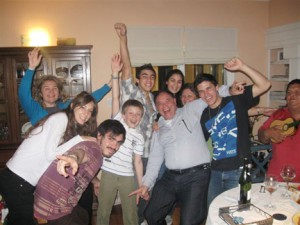
Paul Dean poses with his Argentine host family and friends on his last night before returning to California. (Photo courtesy of Paul Dean)

What also helped Dean fit right in was his love for soccer, as the sport is popular in Argentina.

“I’m a soccer player, but soccer in the U.S. is nothing compared to soccer in Argentina. Soccer is like more than a religion there,” he said.

One of the highlights of Dean’s trip occurred on his second day in the country when a riot broke out following the demotion of River Plate, an Argentinean soccer team.

“For a week, that’s the only thing people talked about,” he said.

While the AFS program is designed to have participants live like locals, Dean also visited tourist sights including La Casa Rosada (which literally means “The Pink House” and is the equivalent of America’s White House), El Obelisco and La Plata.

Dean’s participation in the program was encouraged by his mom Terri, who at one point was an exchange student in Ecuador through AFS. Like her son, Terri’s experience gave her an appreciation of different cultures and people. She also remains in touch with her host family and sees several of them every few years.

“The fact I still have another family in another country and still keep in touch is a pretty special relationship,” she said.

Dean said he recommends the program 110%.

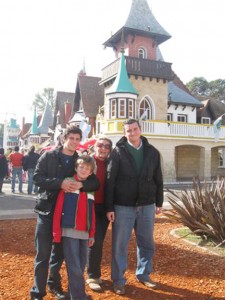
Paul Dean is seen here with his host family at an amusement park, “Ciudad de los Ninos.” (Photo courtesy of Paul Dean)

“If you’re willing to give up one summer … it will change your view and you’ll have a ton of fun doing it,” he said. “It’s hard missing your family [while you’re away], but it’s something that’s worth it. I’m glad I did this while I have time.”

More information about AFS programs is available at www.afsla.org and www.afs.org.